Peer Reviewed Article Paul Gauguin Where Do We Come From? What Are We? Where Are We Going?
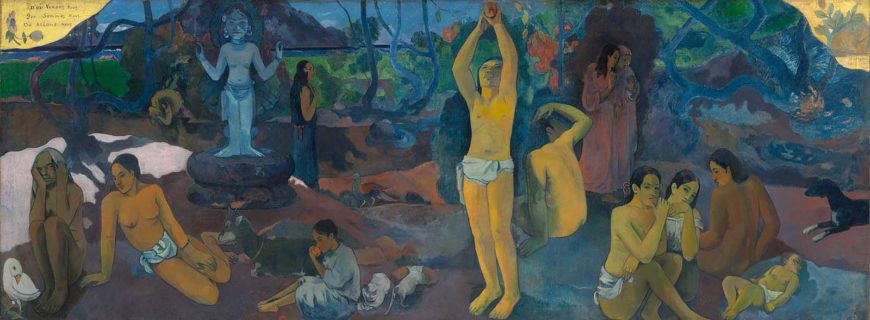
Paul Gauguin, Where do we come from? What are nosotros? Where are we going?, 1897–98, oil on canvas, 139.1 10 374.half dozen cm (Museum of Fine Arts, Boston)
Where do we come from? What are we? Where are nosotros going? is a huge, brilliantly colored but enigmatic piece of work painted on rough, heavy sackcloth. Information technology contains numerous human, animal, and symbolic figures bundled beyond an island mural. The sea and Tahiti's volcanic mountains are visible in the background. Information technology is Paul Gauguin's largest painting, and he understood information technology to be his finest work.
Where are nosotros going? represents the artist's painted manifesto created while he was living on the isle of Tahiti. The French artist transitioned from being a "Sunday painter" (someone who paints for his or her own enjoyment) to becoming a professional person after his career as a stockbroker failed in the early 1880s. He visited the Pacific island Tahiti in French Polynesia staying from 1891 to 1893. He then returned to Polynesia in 1895, painted this massive canvas there in 1897, and eventually died in 1903, on Hiva Oa in the Marquesas islands.
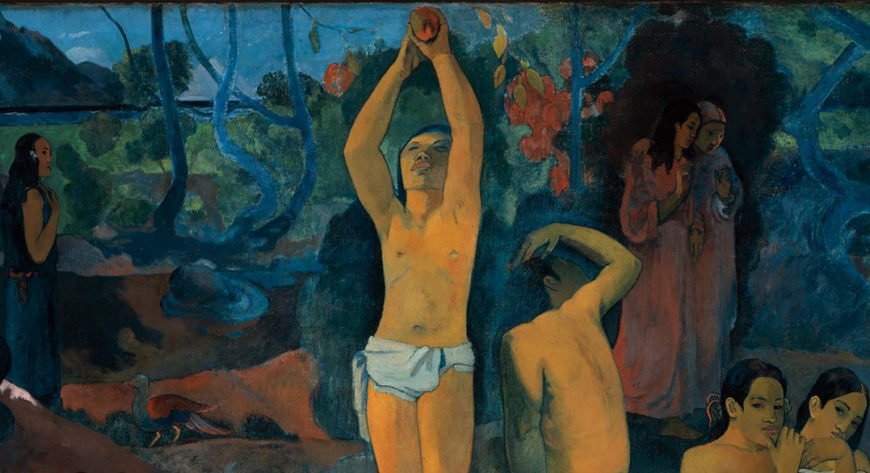
Particular, Paul Gauguin, Where do nosotros come from? What are we? Where are nosotros going?, 1897–98, oil on canvas, 139.1 10 374.half dozen cm (Museum of Fine Arts, Boston)
Gauguin wrote to his friend Daniel de Monfried, who managed Gauguin'southward career in Paris while the artist remained in the South Pacific, "I believe that this canvas not only surpasses all my preceding ones, only [too] that I shall never do anything improve, or even like it." Gauguin completed Where are we going? at a feverish charge per unit, allegedly within one month'due south fourth dimension, and even claimed to de Monfried that he went into the mountains to effort suicide later on the work was finished. Gauguin—ever the principal of self-promotion and highly witting of his image equally a vanguard artist—may or may non take actually poisoned himself with arsenic as he alleged, but this legend was quite pointedly in line with the painting's themes of life, death, poesy, and symbolic significant.
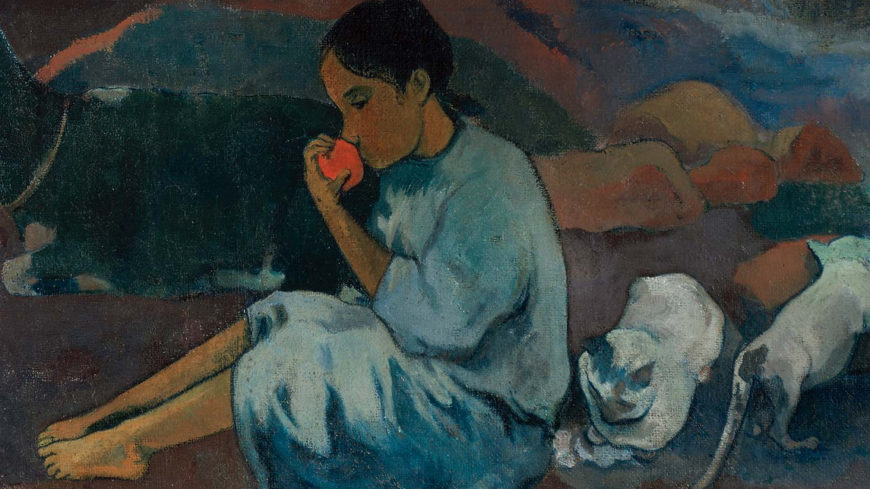
Detail, Paul Gauguin, Where do we come up from? What are we? Where are we going?, 1897–98, oil on canvas, 139.ane 10 374.6 cm (Museum of Fine Arts, Boston)
Gauguin himself provided a telling description of the painting's esoteric imagery in the aforementioned letter to de Monfried, written in February 1898:
It is a sheet four meters 50 in width, past one meter seventy in peak. The two upper corners are chrome yellow, with an inscription on the left and my proper name on the correct, like a fresco whose corners are spoiled with age, and which is appliquéd upon a golden wall. To the right at the lower end, a sleeping child and iii crouching women. Two figures dressed in purple confide their thoughts to 1 another. An enormous crouching figure, out of all proportion and intentionally then, raises its arms and stares in astonishment upon these 2, who cartel to think of their destiny. A effigy in the center is picking fruit. Two cats near a kid. A white caprine animal. An idol, its arms mysteriously raised in a sort of rhythm, seems to point the Beyond. Then lastly, an quondam woman nearing death appears to accept everything, to resign herself to her thoughts. She completes the story! At her feet a strange white bird, holding a cadger in its claws, represents the futility of words….Then I have finished a philosophical piece of work on a theme comparable to that of the Gospel.¹
Non but does Gauguin's text clarify some of the painting's abstract, idiosyncratic iconography, it besides invites us to "read" the image. Gauguin suggests that the figures have mysterious symbolic meanings and that they might reply the questions posed past the work'south title. And, in the manner of a sacred roll written in an aboriginal linguistic communication, the painting is to be read from right to left: from the sleeping babe—where we come from—to the standing figure in the middle—what we are—and ending at the left with the crouching erstwhile woman—where we are going.
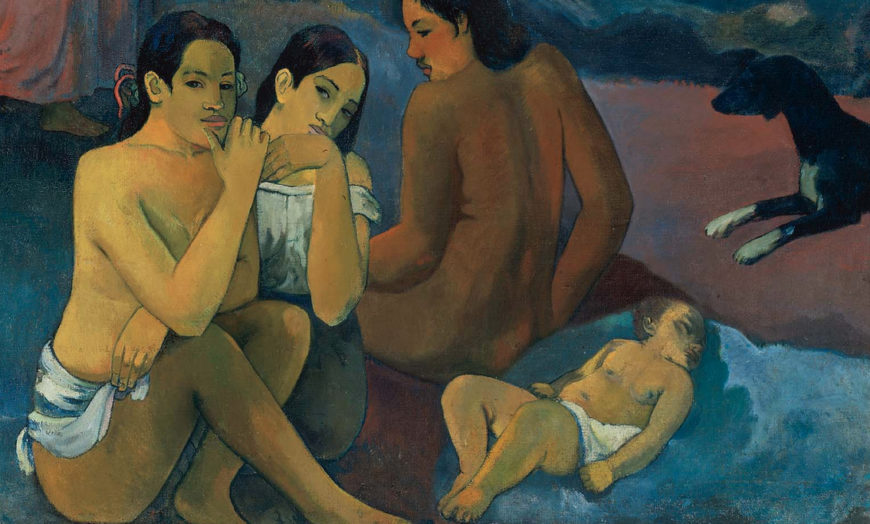
Detail, Paul Gauguin, Where do we come from? What are nosotros? Where are we going?, 1897–98, oil on canvas, 139.i ten 374.6 cm (Museum of Fine Arts, Boston)
Stylistically, the limerick is designed and painted to recall frescoes or icons painted on a gold ground. The upper corners have been painted with a brilliant yellowish to contribute to this event, and the figures appear out of proportion to 1 another—"deliberately and so" as Gauguin wrote—equally if they were floating in space rather than resting firmly upon the earth.
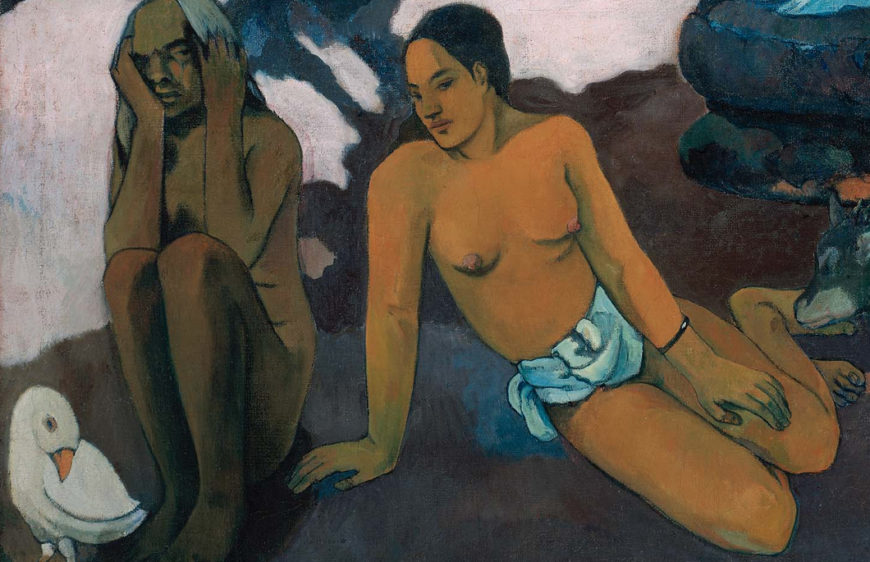
Detail, Paul Gauguin, Where do we come from? What are we? Where are we going?, 1897–98, oil on canvas, 139.1 10 374.six cm (Museum of Fine Arts, Boston)
These stylistic features, forth with Gauguin'southward enigmatic subject contribute to the painting'due south "philosophical" quality. And as is common with other Symbolist works of this period, precise, consummate interpretations of Where practice we come up from? remain out of reach. The painting is a deliberate mixture of universal pregnant—the questions asked in the title are central ones that accost the very root of human being existence—and esoteric mystery. Although Where practise nosotros come from? is painted on a large scale similar to the decorative public panels created past the French artist Pierre Puvis de Chavannes (an artist Gauguin admired), Where exercise we come up from? is essentially a private work whose meaning was likely known only to Gauguin himself.
A few months after completing the painting, Gauguin sent it to Paris forth with several other works of art, intending that they should be exhibited together in a gallery or an artist's studio. He sent de Monfried conscientious instructions virtually how Where exercise we come from? should be framed ("a patently strip of wood, 10 centimeters broad, and white-done to resemble a mural") and who should be invited to the exhibition ("in this way, instead of crowds one tin have whom one wants, and thus gain connections that cannot harm you lot.") The concern Gauguin reveals in the details indicates his continued awareness of the Parisian art market, which remained a central focus even equally he exiled himself on a small tropical island on the other side of the world.
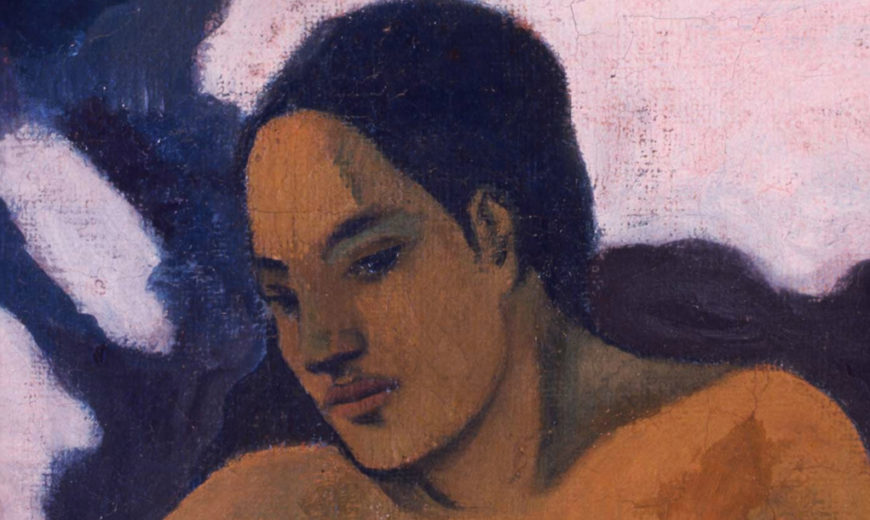
Detail, Paul Gauguin, Where do nosotros come from? What are we? Where are nosotros going?, 1897–98, oil on canvas, 139.ane x 374.6 cm (Museum of Fine Arts, Boston)
In November and December 1898, the group of Tahitian paintings was displayed at the gallery of Ambroise Vollard, a old law student turned fine art dealer who specialized in vanguard artists. Vollard seems to have had difficulty selling the "large picture," as Gauguin called it. Efforts past the artist'southward Parisian friends to collectively acquire the painting and donate information technology to the French state were never realized. Where do we come from? shuttled between galleries and individual collections in French republic and Norway until the Museum of Fine Arts, Boston, purchased information technology in 1936.
ane. "The Wisdom of Paul Gauguin—Artist," International Studio, volume 73, number 291, 69.
Additional resource
This work at the Museum of Fine Arts, Boston
Symbolism on The Met's Heilbrunn Timeline of Art History
Source: https://smarthistory.org/gauguin-where-do-we-come-from-what-are-we-where-are-we-going/
0 Response to "Peer Reviewed Article Paul Gauguin Where Do We Come From? What Are We? Where Are We Going?"
Post a Comment